There’s a simple idea in mathematics: big outcomes are built from small, consistent units.
A hundred is just ones, added together. A lakh is just thousands, repeated enough times.
And zero–especially when it comes to disease–is not a starting point. It is something you arrive at, carefully, by reducing every single unit that exists.
India’s goal of a TB-Mukt Bharat rests on this idea.
It is not one sweeping achievement. It is the sum of many smaller ones- states, districts, communities–each moving towards the same endpoint. A TB-free India is built state by state- and within them, district by district, block by block, village by village.
Which raises a more fundamental question: what does “TB-free” actually mean?
It is not just about lowering case numbers. It is about stopping transmission- by identifying cases early, treating them completely, and ensuring the disease has nowhere left to spread.
In other words, it is not enough to treat TB well. You have to find it everywhere it exists.
And that is where the challenge begins!
Because not all TB announces itself.
Some patients do not walk into health facilities. Some do not recognize their symptoms early enough. And some do not show clear symptoms at all.
These are the cases that stay outside the system–continuing their daily lives, unaware, while the disease quietly spreads.
This invisible layer is what makes elimination hard. Because even if every patient who comes forward is diagnosed and treated perfectly, the chain of transmission does not fully break.
For a long time, TB detection largely followed a predictable path- identify symptoms, then test. It worked well for those who entered the system.
But it left behind those who didn’t.
In Jhalawar, Rajasthan, at the frontline, this gap was something health workers have seen up close.
“If I had to screen 100 people, I had to refer all 100 for further tests,” Tej Karan, a Community Health Officer explains. “It took time, and not everyone would go.”
The effort was there. But the system was still, in many ways, waiting. That began to change when screening itself moved closer to where people are.
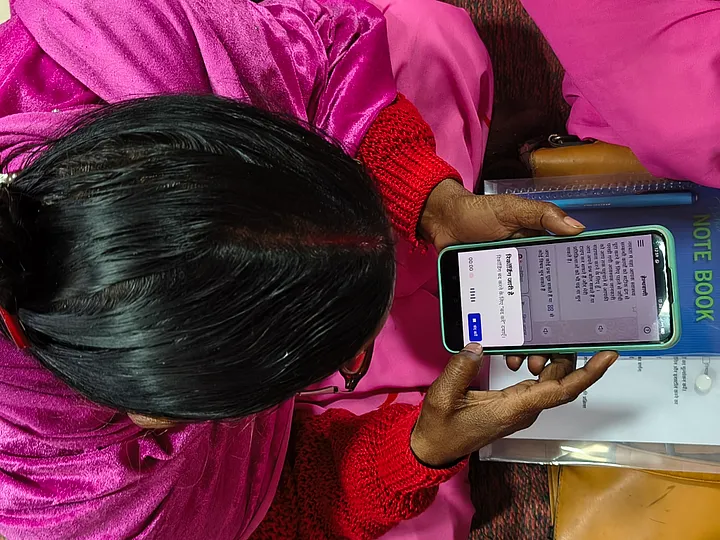
Using the Cough Against TB (CATB) application, developed by Wadhwani AI, health workers are now able to screen individuals in minutes–combining basic symptom information with a simple cough sound recording. Instead of relying only on visible symptoms or sending everyone for further tests, the application helps flag presumptive TB cases for confirmatory testing, including some individuals who may not report typical symptoms.
“Now if I screen 100 people, only a few need to be referred,” the CHO says. “We can identify who actually needs further testing.”
The shift is subtle, but important.
It reduces the burden on the system and makes screening faster and easier.
But most importantly, it widens the net.
Because screening is no longer limited to those who actively report symptoms or seek care, it becomes possible to reach people sooner- sometimes before they would have entered the system at all.
This is where Dr Mukesh Kumar Bansal, the District TB Officer sees the larger impact.
“We were finding the patients who came to us,” he reflects. “But the real question was- who are we missing?”
By enabling community-level screening and looking beyond reported symptoms, this approach begins to close a critical gap. Across deployments, it is already revealing that some individuals who test positive for TB do not report typical symptoms–pointing to a layer of the disease that is harder to see, but essential to address.
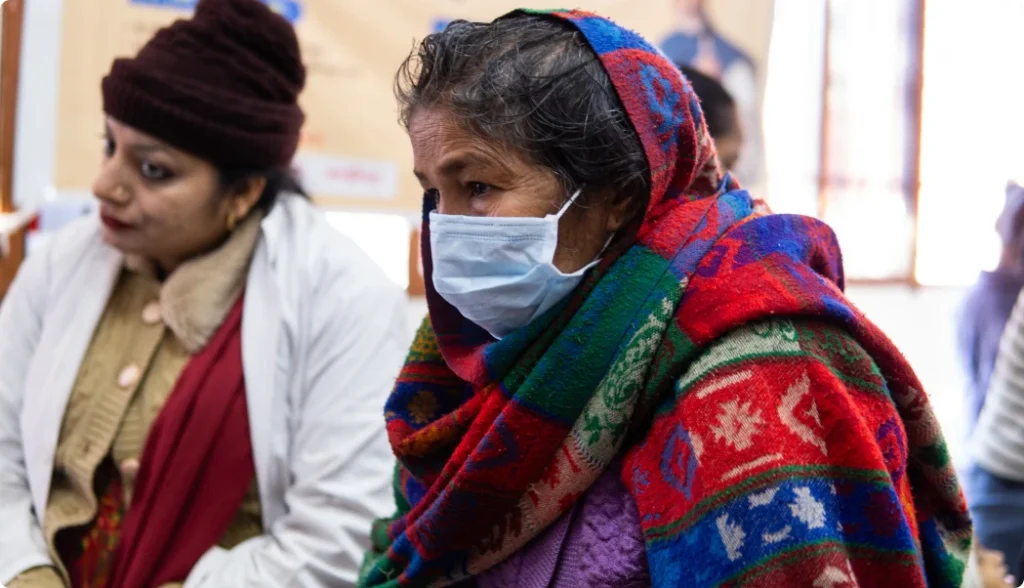
During one such round of community screening, Pana Bai, 67, was screened using CATB. There were no clear warning signs, no TB-related concerns; nothing that would have pushed her into the system.
Like many others, she might not have sought testing at that point. But the screening flagged her as a presumptive case.
Follow-up testing confirmed the diagnosis, and treatment was initiated. Under earlier approaches, she may not have been identified at that stage.
— — —
It is a small story, but it points to something much bigger.
Because for every one such case identified early, there are many more who might otherwise remain undetected- continuing the chain of transmission without ever appearing in the data.
Tools like Cough Against TB are not just helping find more patients- they are helping find them earlier, and in places where the system was not always looking.
And that changes what progress looks like.
Because getting to zero is not just about reducing numbers. It is about making sure nothing is left uncounted.
In Jhalawar, this shift is already underway. The Cough Against TB solution- an AI-enabled tool that analyzes cough sounds to identify individuals at risk of TB- is enabling rapid, non-invasive screening at the point of care. By supporting large-scale, community-based screening, it allows health systems to move beyond symptom-based detection and strengthen early identification.
Because in the end, a TB-Mukt Bharat will not be built only by treating the patients we see.
It will depend just as much on finding the ones we don’t.
This deployment in Jhalawar was supported by Genpact, enabling the integration of AI-led screening into routine frontline workflows. Across geographies, Wadhwani AI’s CATB solution has contributed to identifying an additional 12–16% of TB-positive individuals who were asymptomatic at the time of screening- cases that would likely have been missed through conventional approaches, underscoring the importance of expanding how we find TB.