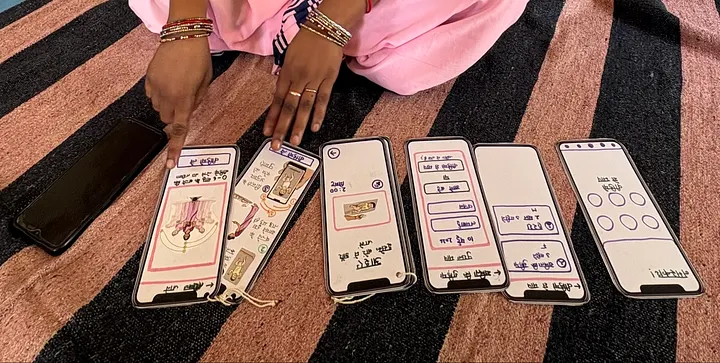
“Sometimes I practice at home, alone because English as a language is important to get a job.”
I was sitting across from an ITI student in Mysore. I had asked him a simple question: why don’t you speak English in class? He paused for a moment. Then he said he was afraid other students would laugh at him. He said even his teachers taught in the local language and not English. So he went home every evening, closed the door, and practiced alone.
I wrote that down in my notebook. But I already knew I wouldn’t forget it.
That one answer became the foundation for almost every design decision we made on SEAP (Spoken English Assessment & Practice), Wadhwani AI’s AI-powered spoken English platform for students across undergraduate and postgraduate colleges, ITIs and polytechnics in India.

A researcher in conversation with a student during a one-on-one interview at a Government ITI in Bengaluru. Faces blurred to maintain privacy. Image courtesy: Wadhwani AI
We realized that we started with the wrong problem
When we first began building SEAP, we were focused on English, broadly — Reading. We built 100 passages for students to practice reading. Uptake was decent. On paper, things looked like they were working.
Then we went to the field.
We visited ITIs Bangalore, Mysore, Hyderabad, and Pune. We spoke to students in their classrooms, instructors in their staffrooms, training officers in their offices. And in one of those sessions, something stopped us cold. A student was using the app but hadn’t spoken a single word. He was reading the passage silently, in his head, thinking that was what the app wanted. He had never pressed Record. The task instruction wasn’t clear enough. The product we had built was confusing the very people it was meant to help.
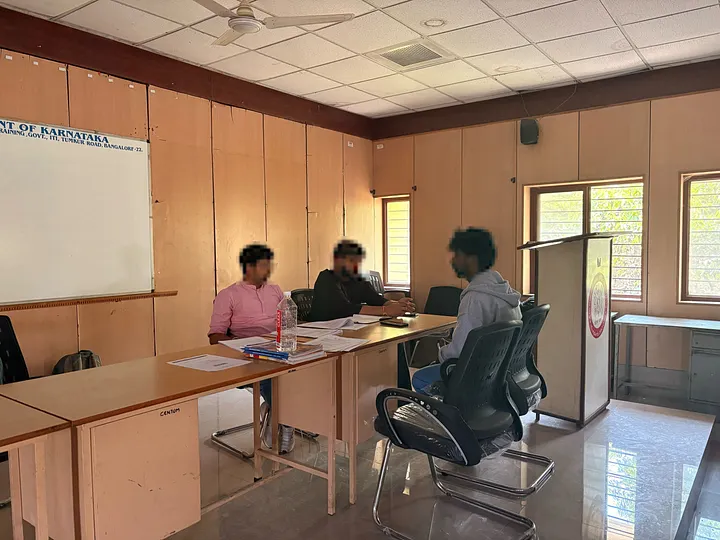
Our team interviewing a student at the Government ITI in Bengaluru, Karnataka. Faces blurred to maintain privacy. Image courtesy: Wadhwani AI
But more than the UX failure, what stayed with us was the reason he hadn’t asked for help. He didn’t want to look like he didn’t know what to do.
That is when we stopped building a reading app and started building something else entirely.
The real design constraint was not what we expected
When most teams design for “underserved learners,” the conversation quickly goes to familiar places. Low bandwidth. Small screens. Regional languages. Digital literacy. These are real constraints. We dealt with all of them.
But none of them was the hardest thing to design for.
The hardest thing was shame. Shame about not being able to speak English, and about not being able to cope with the pressure when peers speak fluent English.
In every ITI we visited, English class officially happened in English. In practice, it often happened in the local language, because teachers who were never trained to teach English defaulted to what they knew. Students get maybe 10 minutes a week of actual English practice, squeezed between a packed syllabus and the pressure to cover theory for practical exams.
And in those 10 minutes, students didn’t speak. Because if you got it wrong, someone laughed.
An instructor in Karnataka told us plainly: “Exposure is the main problem. Nobody is there to speak in English.”
A student in Telangana put it differently: “If you speak English wrong in public, your image suffers.”
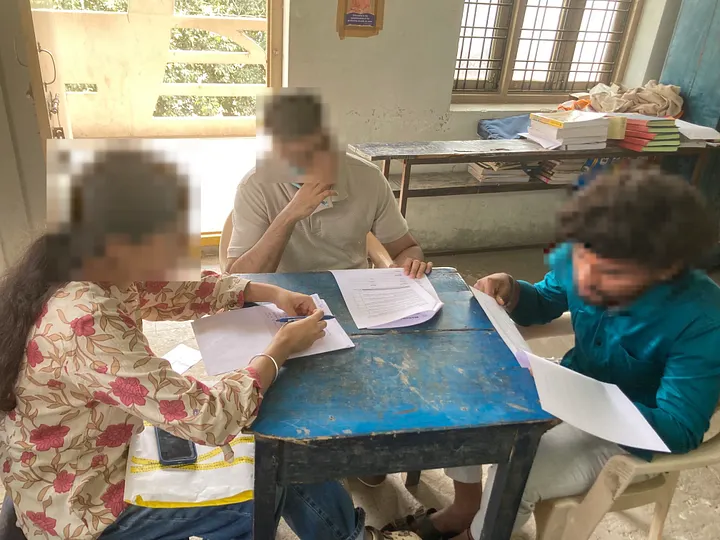
A user research session in progress, with notes taken alongside printed research materials. Faces blurred to maintain privacy.
Image courtesy: Wadhwani AI
We had walked into these classrooms thinking the problem was access. We walked out understanding it was something older and harder to fix. These students had spent years learning, consciously or not, that speaking English in front of others was a risk not worth taking. The embarrassment of getting it wrong in public was heavier than the regret of not trying.
So they found the only safe place they could. Home. Alone. At night. When nobody was watching.
We were not designing a language-learning app anymore. We were designing a practice room where it was safe to fail out loud, for someone who had never had one.
What that realization changed
Once you understand that shame is the design constraint, almost every decision looks different.
The first thing we did was go through every piece of UX copy in the product and rewrite it. Words like “wrong,” “incorrect,” and “try again” had to go. “Try again” sounds like a verdict. Like you failed, and now you have to redo it. We replaced everything with language rooted in nonviolent communication, language that said: This is practice, not a performance. Mistakes are part of the process, not evidence that you cannot do this.
It sounds small, but it is not.When your user walks in already convinced they will be judged, because every classroom they have ever sat in has confirmed that belief, every word on screen either reinforces that fear or quietly pushes back against it. We chose to push back.
The second change was in how exercises felt. Anything that looked like an exam (a formal layout, strict time pressure, a score at the end) triggered the same shutdown response as a classroom. Students disengaged, not because they didn’t want to learn, but because their nervous systems had been trained to associate that format with public failure. So we redesigned every exercise to feel game-like. Interactive. Low-stakes. Something you would want to try, not something you had to get through.
We even rethought the typography. We chose a rounded, friendly typeface for the entire product. Because visual tone sets the emotional register of an app before a single word is read. If the font feels clinical or cold, the user is already on guard. We wanted them to feel, from the very first screen, that this place was different.
Designing for a country, not a demo
Every student we met was different. Each brought a completely different accent, rhythm, and way of shaping English words, and each came from a classroom where no one had ever told them their accent was something to be understood, not corrected.
And here is the technical reality we ran into: our AI broke on accents it had not heard.
Proprietary automatic speech recognition (ASR) models are largely trained on a narrow band of English. They work reasonably well for a certain kind of speaker. For the students we were designing for, they failed in predictable, frustrating ways. So we did something that sounds simple but was actually a massive exercise: We collected speech data from every district in India. Not to hit a diversity metric, but because the model needed to hear these voices to serve them.
Designing for diversity stopped being a value statement. It became a hard technical requirement.
We also faced a tension around language itself. Our first instinct was: if students are struggling with English, make more of the product available in their native language. But that instinct was wrong. A student who comes to SEAP to practice spoken English does not need an escape route from practicing spoken English. What they need is for the hard parts to not be harder than they have to be.
So we made a deliberate split. We made the instructional parts multilingual: how an exercise works, what to do next, how to navigate. Because the cognitive load of parsing English instructions should not get in the way of the actual learning. But the learning content itself stays in English, leveled so students start where they actually are, and mapped to the ITI employability curriculum: the vocabulary of factory floors, HR interviews, and workplace communication. The things they told us they actually needed English for.
The room they deserved
That student in Mysore is not unusual. We met many students like him in Bangalore, Hyderabad, and Pune. Different names, different trades, different mother tongues. Same fear. Same quiet workarounds: Google Translate for pronunciation, WhatsApp voice notes to hear correct sounds, ChatGPT to simplify textbook language. Students built their own makeshift practice rooms out of whatever they had, because the classrooms and corridors were not safe enough.
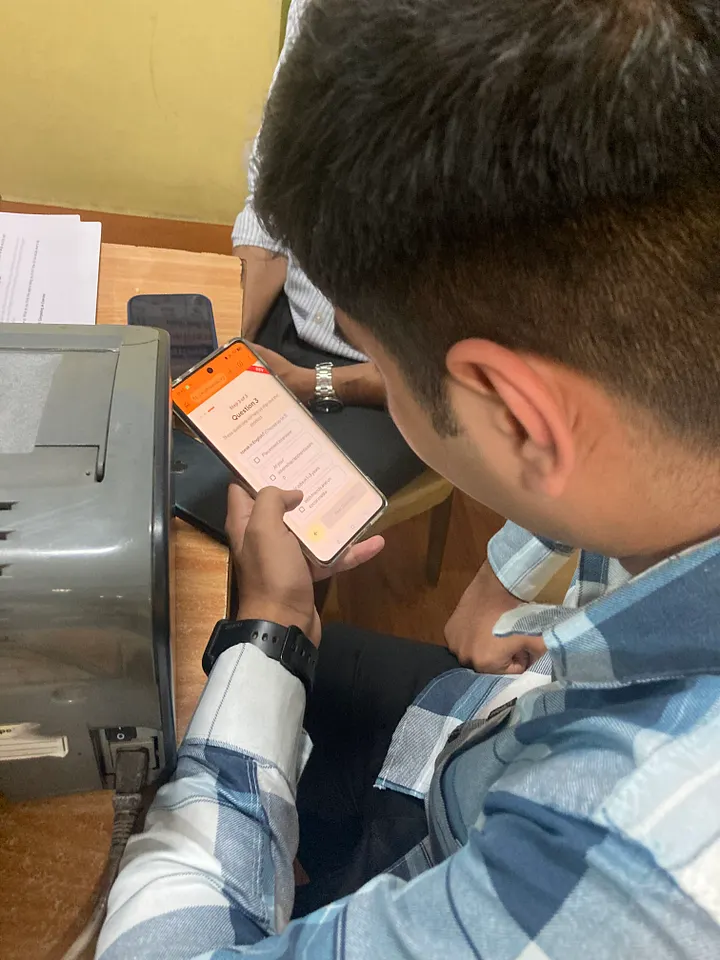
A student answering SEAP’s onboarding question about where he needs to speak English.
Image courtesy: Wadhwani AI
SEAP is our attempt to build them a better one. A room where the AI does not judge you. Where the copy does not shame you. Where the exercises feel like play. Where every accent from every district in India is something the model was trained to understand.
We do not know yet whether we have built it well enough.
But we know what it needs to feel like.