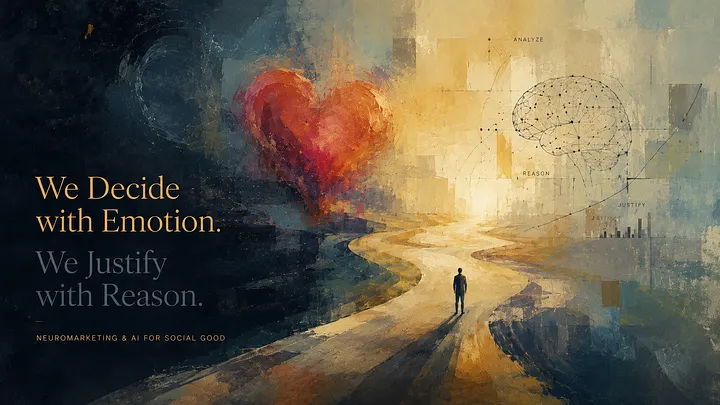
We like to believe our decisions are rational. Neuroscience says otherwise. Most decisions are made emotionally first, then justified with logic — a sequence the phrase “rational decision” actually reverses. The gut decides. The brain explains. This is the foundation of neuromarketing, a field that reveals why some messages move people while others vanish without a trace.
Three Brains, One Gatekeeper
Morin and Renvoisé, in Neuromarketing: Understanding the “Buy Buttons” in Your Customer’s Brain, identify three brain layers: the New Brain (reason and language), the Middle Brain (emotion and social bonds), and the Old Brain (survival, instinct, fight or flight). The Old Brain acts as the gatekeeper. It decides first. The New Brain arrives later with a rational story to match the choice already made.
Six Triggers That Bypass Logic
The Old Brain does not deliberate — it scans for shortcuts. Six levers activate it reliably.
Self-relevance: if the message doesn’t answer “What’s in it for me?”, it is ignored.
Contrast: before/after, problem/solution — polarity enables fast judgment.
Tangible proof: vague claims disappear; specific evidence sticks.
Beginnings and endings: the middle is forgotten — the serial position effect is not a quirk, it is a rule.
Visual priority: the eye processes imagery in two milliseconds; auditory signals take 500.
Emotion: dopamine and cortisol sharpen attention and lock in memory.
Functional MRI studies confirm the sequence: activity spikes in the amygdala and striatum — the instinct and reward centers — before subjects can articulate why they responded to a message at all. The gate opens or closes in the first 30 seconds. Everything after that is reinforcement or friction.
When AI Earns Trust Before It Earns Scale
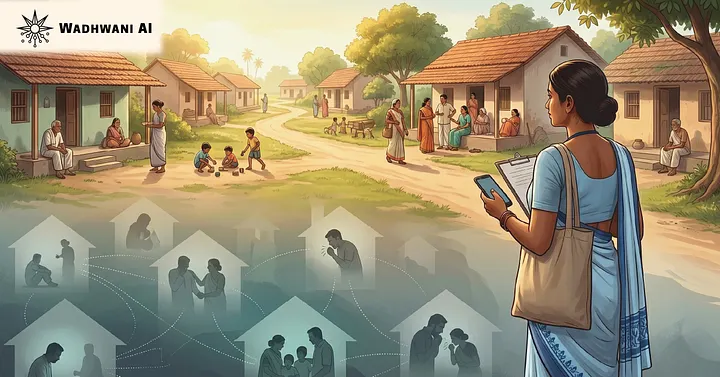
At Wadhwani AI, we build artificial intelligence solutions for underserved communities across India; in healthcare, agriculture, and education. What we have learned, over years of deployment across diverse geographies, is that technology alone does not scale. Trust does. And trust, it turns out, is not a rational transaction. It is an Old Brain event.
In Vidarbha, Maharashtra’s cotton belt, where nearly 100,000 farmers lost their crops to pink bollworm infestations in 2017–18, we deployed CottonAce, an AI-powered pest advisory system. A smallholder farmer with a two-acre plot and a lifetime of accumulated skepticism does not adopt a new tool because it has a high accuracy score. They adopt it when the village lead farmer, someone they trust, walks them through the app, shows them the pheromone trap data, and demonstrates that the system caught an infestation two weeks before it was visible to the naked eye. By the 2021 Kharif season, CottonAce was being used by over 6,000 farmers across 60 districts and 10 states. The contrast, reduced pesticide costs against a history of devastating losses, spoke directly to survival instincts. That is the Old Brain responding to tangible proof.
In Gujarat, we partnered with the state government to deploy an AI-based oral literacy assessment tool across 33,000 schools. A teacher in a rural district near Rajkot does not need a whitepaper on speech-to-text models. She needs to see a child assessed in real time, mispronounced syllables flagged instantly, and a path to targeted intervention, all without adding to her already impossible workload. By March 2025, the tool had conducted more than 3.6 million student assessments. The emotional trigger was not technological wonder. It was relief: a teacher finally seeing which child needed help and how.
In tuberculosis care, where India carries the highest burden of cases globally, our TRACE-TB program works with the Ministry of Health and state health systems to predict which patients are most at risk of not completing treatment. A health worker in a dense urban cluster in Delhi or a remote block in Jharkhand does not scale a government program because the data is compelling. She scales it because the system tells her exactly where to focus her limited hours, and the early interventions prove themselves. Credibility compounds. Trust migrates upward from the frontline worker to the district health officer to the ministry.
The common thread across these deployments is not the sophistication of the AI. It is the architecture of trust that precedes it. We embed AI units within partner organizations. We make government our closest collaborator, not a stakeholder to be managed. We design for the constraints of the ecosystem; low connectivity, mixed digital literacy, a deep well of historical disappointment with interventions that promised and disappeared. Each of these choices is an answer to the Old Brain’s primary question: “Is this safe for me?”
What This Means in Practice
Whether you are a marketer, a policy designer, or a technologist attempting to create impact at scale, the operating principle is the same. Open strong, close even stronger; never bury the critical point in the middle. Replace abstraction with vivid, specific contrast. Wrap numbers inside human stories. And in every interaction, answer the question the Old Brain is silently asking before it will let anything else through.
“We are not thinking machines that feel; we are feeling machines that think.”
– Antonio Damasio, Neuroscientist